Giving a stoic horse
a new way to say something.
Charlie uses recordable buttons. We use them to give a horse who hides pain a way to point me toward what his body needs.
01: WHAT THIS IS
This started as a curiosity. It has become something I take seriously, and document carefully.
Below is what the project actually is, what I hope it can do, and the real limits of what one horse and one pretty determined owner can prove. No overselling. Just the work, laid out plainly.
02: THE HOPE
An earlier warning, not a conversation.
Horses are prey animals. They hide pain. It is wired into them, and it is why a horse can be hurting well before anyone sees it. Charlie is especially good at hiding it, and he carries a real medical history, cervical changes, treated EPM, chronic Lyme, metabolic risk, that can cause discomfort he does not always show.
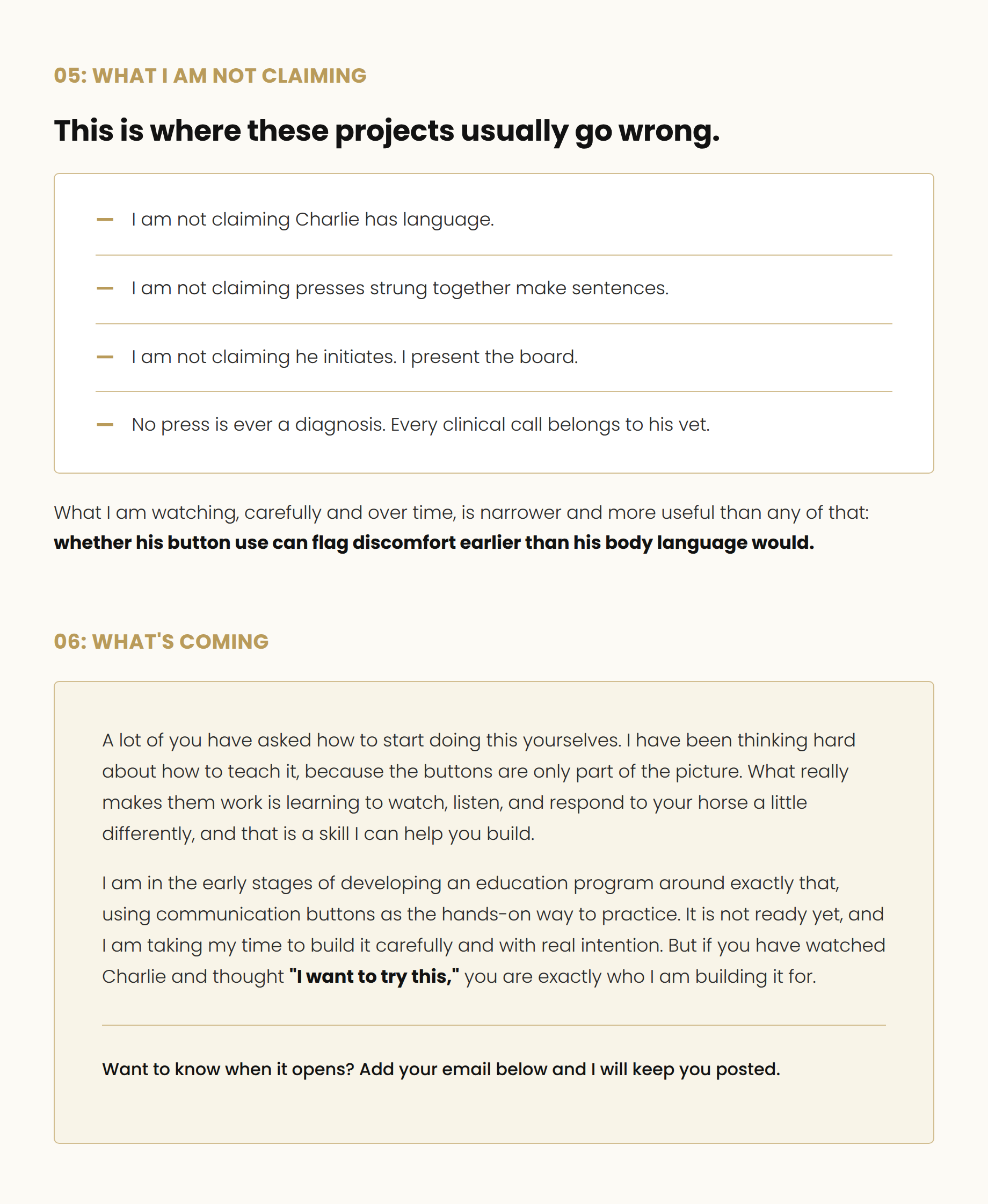
So the question driving this whole project is simple to say and hard to answer: can a set of buttons help him tell me something is wrong earlier than his body would otherwise let on?
That is the hope. Not language. An earlier warning. If a button press can point me toward a sore foot or a stiff neck a few days before it becomes an obvious problem, that is a horse who gets help sooner. For a stoic horse with a complicated body, that could matter a great deal.

03: HOW IT CONNECTS
This comes from the same place as everything else I do. My work is built on a single idea, the one above. The Connected Care File does it with a horse's documented history. The buttons are the live, in-the-moment version of the same instinct: watching closely, taking what Charlie shows me seriously, and connecting it to what I already know about him.
04: THE RIGOR
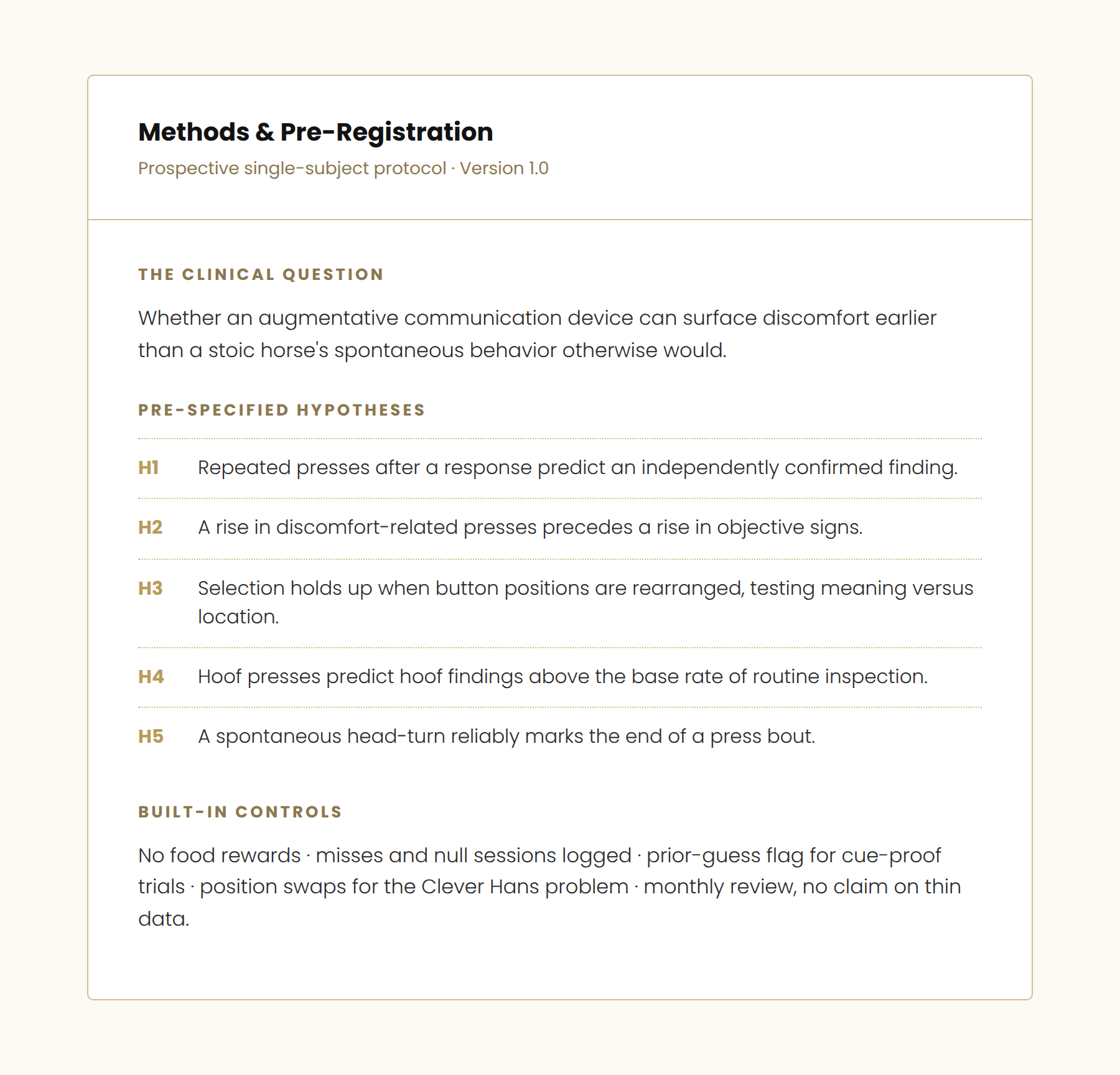
Charlie is not a simple case. Between his neurologic history, the metabolic picture, and everything his body quietly manages, the stakes of reading him wrong are real. So when something looks like a signal, I want to know whether it actually is one, not just hope.
That is why I keep this structured rather than casual. Predefined questions I am testing, the misses logged right alongside the hits, no food rewards so a press means something, and controls for the obvious traps like him reading me instead of the buttons. Not to be scientific for its own sake, but because a horse this complicated deserves more than a guess.
And there is a bigger hope behind it too. Careful observation of one horse will never answer the large questions about how animals think and communicate. But done honestly, it can add a small, real piece to them. If Charlie's story can contribute even a little to how we understand animal cognition, that is a horse whose complicated life ends up meaning something well beyond our barn.
The full study brief is below for anyone who wants to see exactly how I keep myself accountable. It is detailed, and it will be more than most people want, and that is okay.